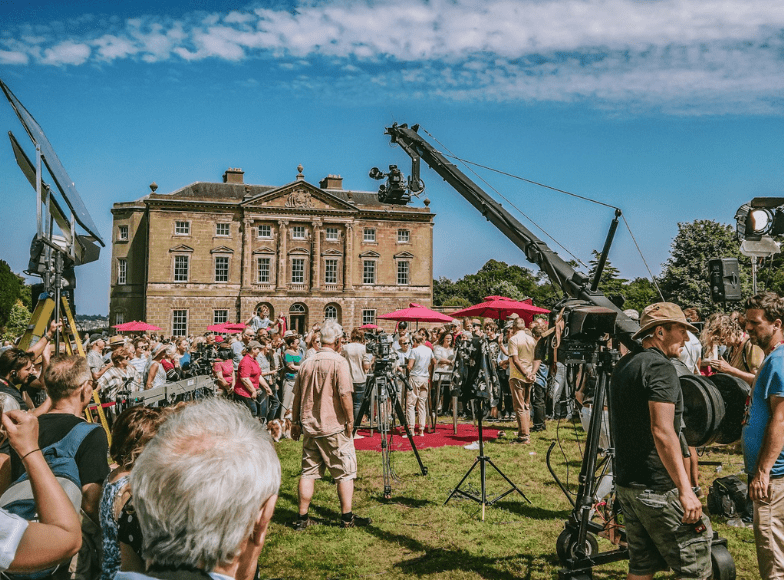
What does building restoration have in common with Hollywood? More than you might think.
In both film productions and restoration projects, teams assemble according to a project’s unique goals and requirements, work together for the duration of the project, and then disperse. In both cases, the whole team may never physically meet, and no individual has sufficient knowledge or capacity to accomplish the task alone.
The “credits” for a restoration project would include the owner, the architect/engineer, and the contractor. They’d include subcontractors, specialized subconsultants, attorneys, project managers, project accountants, managing agents, product reps, and DOB expediters and examiners. And of course, those who perform the actual “hands on” work or manufacture products or materials: riggers, laborers, supervisors, mechanics, craftsmen, delivery drivers, equipment operators, and material manufacturers.
Neither filmmaking nor restoration offers the economies of scale of conventional manufacturing. (Without economies of scale, a Ford F150 might cost a million dollars). So, we embrace systems that provide consistency of performance and promote institutional memory from one project to the next, approximating the benefits of factory production.
That’s one reason we’ve developed tools like our Restoration Assembly Detail (RAD) markers, our Asset Information Management (AIM) system, and SufaceCapture.
In our role as restoration Engineer/Architect, SUPERSTRUCTURES typically receives top billing—actors in Hollywood fight over that. But we appreciate and respect the role that everyone plays in a successful restoration project.
14 Wall Street, 25th Floor, New York, NY 10005
(212) 505 1133
info@superstructures.com
Subscribe to SuperScript, our email newsletter.